
Cyberport’s journey to becoming an AI-first company
From manual development cycles to a software factory with autonomous agents.
Building a measurable AI-first software factory
In a highly competitive market, standard SaaS solutions no longer provided Cyberport with the flexibility required for true differentiation and development speed.
To radically boost innovation and reduce time-to-market for new features from weeks or months to just days, Etribes designed a measurable AI-first software factory. The result: nine highly specialized, autonomous agents that reliably produce code behind deterministic quality gates.
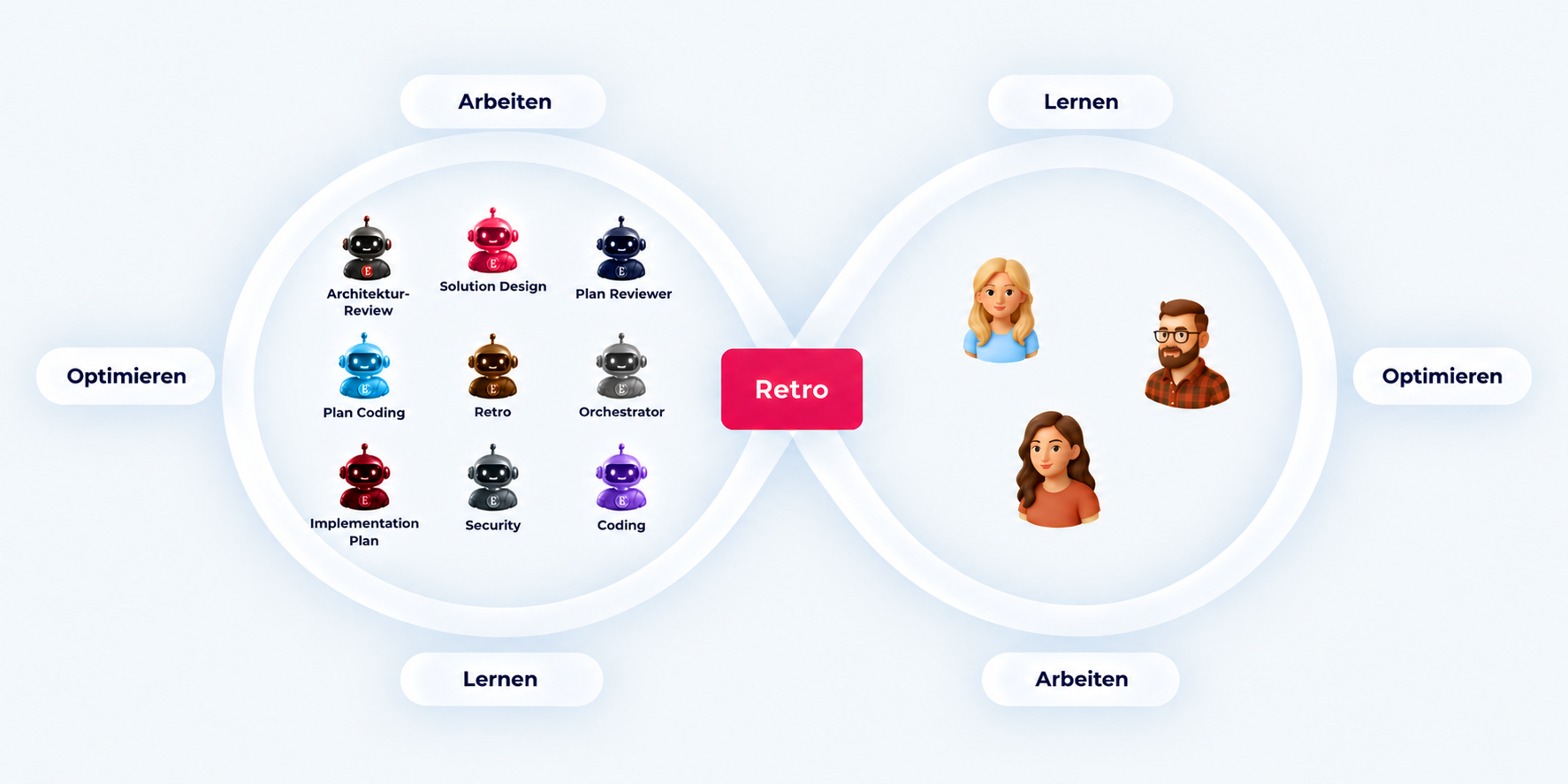
The focus was on establishing an organizational learning system. AI agents handle software development, while humans steer and approve at defined checkpoints.
Cyberport faced the strategic challenge of regaining its competitive edge through tailored technological solutions rather than being limited by off-the-shelf software. To achieve this, an intensive AI engineering sprint laid the foundation for future-proof, AI-powered software development.
Internal software development served as the ideal starting point for gradually aligning the entire organization with an AI-first approach. Instead of relying on isolated AI support, we designed a full-scale, agent-based AI infrastructure in collaborative workshops. This resulted in a framework of nine specialized, autonomous agents—including those for architecture review, solution design, security, and coding—that solve complex tasks collaboratively.
The focus was on three core areas: specialization to tame unpredictable AI models, building trust through verifiable work logs, and control via deterministic quality gates in the code. To ensure consistently high code quality, every agent generates standardized documents for seamless documentation. The agents work seamlessly in the background on existing systems like Jira or GitHub, while developers provide critical approvals through human-in-the-loop processes and continue to train the system through ongoing feedback.
To objectively evaluate increased developer productivity, tailored factory metrics (such as lead time per ticket, token costs, and gate results) were implemented. This blueprint enables Cyberport to sustainably increase development speed and position itself as a long-term technological leader in the market.
We’ve tried building tools ourselves in the past, but only now are we building one from the ground up in this way and learning how to use these frameworks correctly. It’s about automating processes in a targeted way, while involving our people where human responsibility is required—not against each other, but clearly with each other.
Florian Kiel, Head of E-Commerce

The five-phase project approach
We started in internal software development as the most controllable training ground for the entire organization. In collaborative workshops, we designed a framework with nine focused, autonomous agents that take on specialized task areas such as security or coding.
To ensure full transparency, every agent leaves behind a verifiable work log in the form of standardized documents after completing its task. No agent finishes its work unchecked, which ensures clean documentation throughout the entire development process.
Process logic and approvals were decoupled from unpredictable AI models and moved directly into the code. These deterministic quality gates make iterations reproducible and reliably auditable for enterprise requirements.
Final responsibility always remains human, which is why clear human-in-the-loop processes were established for critical decisions like code reviews. Through scheduled retrospectives, the system continuously learns from human feedback.
To guarantee scalability and make business impact measurable, we implemented specific factory metrics. We track KPIs such as lead time and token costs to systematically manage long-term business value.
The AI-First Strategy
Foundation & Governance: Agentic development and deterministic quality gates function reliably, with human approvals seamlessly integrated into the process.
Speed & Efficiency: Development speed is being drastically increased, with the clear goal of delivering new features in just three days in the future.
Scaling & Automation: The established human-AI governance model is being scaled as a blueprint across other systems and business units.
More projects
.png)
.jpg)
%20(1).jpg)
%20(1).jpg)
.jpg)




With practical experience from founding start-ups, managing companies and more than 250 digital projects, we know how to master digital transformation.