
In almost every prioritization meeting, the same questions eventually arise: Which fix has the biggest impact? Where do we start? The answer usually depends on who argues the loudest – not on what the data says. This article describes how Etribes closes exactly this gap.
The most expensive inefficiency in digital sales
Many e-commerce and digital leaders are familiar with the problem: the performance marketing engine is running at full speed, customer acquisition costs (CAC) are meticulously optimized, campaigns are granularly managed, and qualified traffic flows continuously into digital channels. Yet, at the end of the value chain, the system breaks – the conversion rate falls far short of expectations.
The problem is not a lack of demand, but an inadequate ability to convert that demand into revenue through a seamless customer journey. When users systematically drop off at critical points due to poor user experience (UX), the entire media spend is wasted. This results in massive revenue loss due to friction-heavy interfaces (so-called "broken interface revenue loss") – a direct loss of revenue that shows up immediately in the profit and loss (P&L) statement, but is often not recognized as an isolated UX problem.
The limits of quantitative funnel analysis
To bridge the gap between traffic and conversion, companies invest significantly in analytics. However, pure conversion funnel analysis remains diagnostically incomplete. While quantitative tools (such as heatmaps or session recordings) show with high precision where the funnel breaks – for example, through rising abandonment rates in the checkout process – the organization lacks the qualitative insights for the why.
This gap leads to predictable inefficiencies: tech and product roadmaps stall. Instead of systematically identifying the true friction points, subjective preferences and opinions about interface design dominate the discourse – rather than reliable data.
For CMOs, CPOs, and Heads of Digital Sales, this creates a clear strategic requirement: without reliable data on which UX optimization delivers the highest P&L impact, developer resources are tied up in features that generate no measurable uplift. The necessary UX investment can only be justified if isolated usability hurdles are translated into hard business metrics through a data-driven methodology, rather than gut feeling.

The Conversion Design Audit
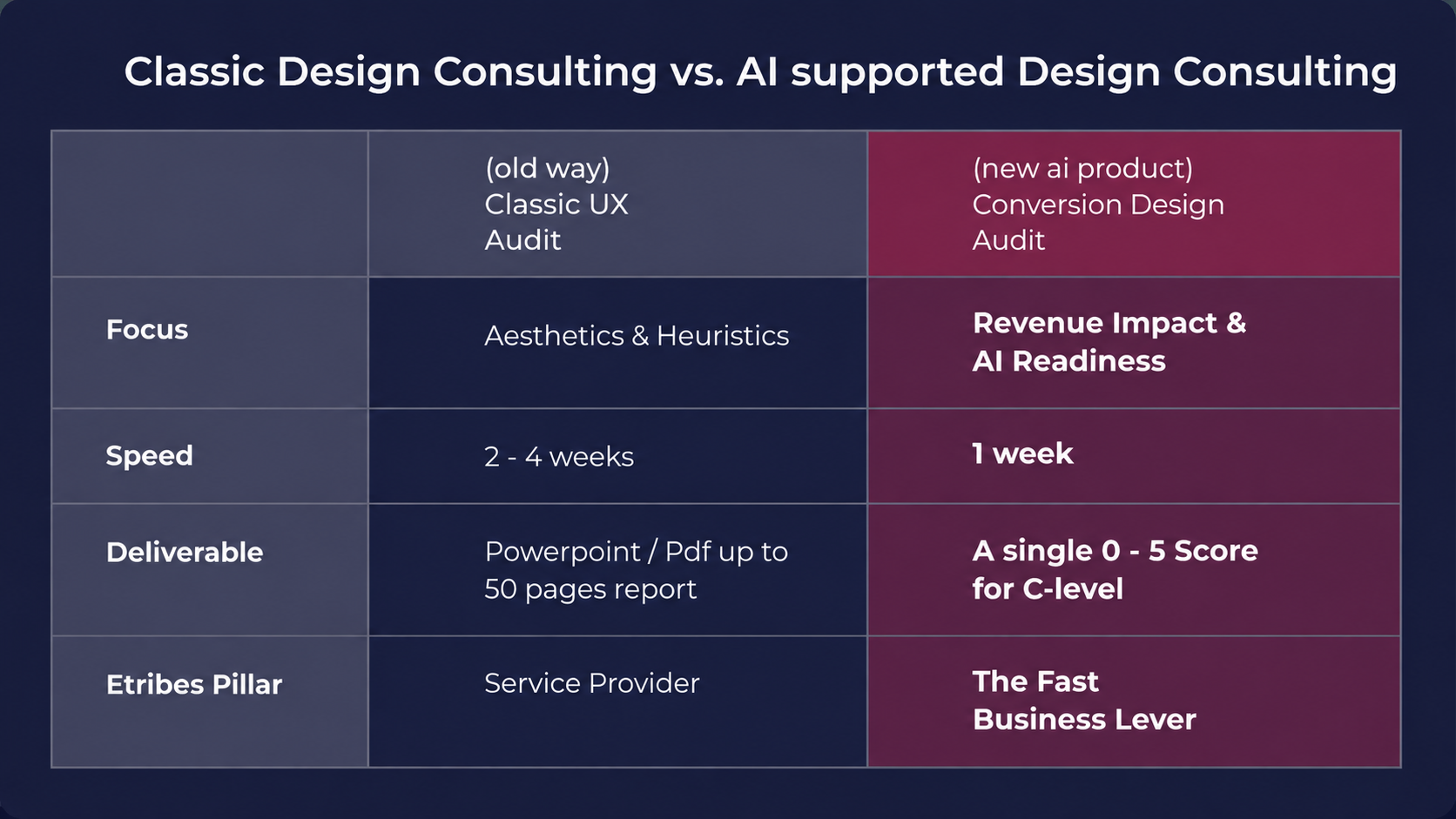
Because pure analytics data is not enough as a basis for decision-making, Etribes has developed the Conversion Design Audit. This is not a classic, months-long design exploration, but a structured analysis at the intersection of UX expertise and conversion data – a true CRO audit for e-commerce.
The core of this approach lies in consistent quantification: the audit calculates the exact financial impact of flawed interfaces and transforms subjective design opinions into prioritized business decisions.
Instead of tying up development resources without a validated business case, the process goes through three focused phases to deliver reliable results quickly – even before the first line of code is written:
1. Identify UX friction points
First, our experts link existing quantitative drop-off data with qualitative usability audits. By precisely mapping the
abandonment points along the user journey, we pinpoint the actual reasons for drop-offs—the so-called UX bottlenecks. This phase is not about visual preferences, but about systematically uncovering the usability issues that operationally prevent users from completing their tasks.
2. Quantifying the ROI of specific UX fixes
In this step, the conversion audit translates usability hurdles into strategic business metrics. The identified friction is benchmarked and converted into concrete financial values. This is based on a combination of the client's existing traffic and conversion data, industry benchmarks, and a structured assessment of friction severity—the result is not an estimate, but a transparent calculation used to determine the exact UX ROI. This allows you to pre-determine the conversion uplift and additional revenue that can be realized by specifically resolving a friction point in the registration or checkout flow, thereby sustainably reducing cart abandonment.
3. Delivering a solid business case
The final deliverable is not an abstract design concept, but a quantified revenue impact report. This provides absolute clarity for decision-making regarding where
investments in user experience should be prioritized to stop immediate revenue loss and sustainably secure the efficiency of your marketing spend.
Case study: Growth turnaround instead of burning budget
A project conducted by Etribes with an established B2B digital player in the DACH market demonstrates the leverage this data-driven approach provides in practice.
The starting point: A massive growth blocker
The company was in a critical phase: its B2B digital run rate and channel performance had dropped by 20 to 25% year-over-year, with drastic weaknesses in mobile conversion and mobile UX. Aggressive promotional campaigns and high media spend were ineffective because the traffic failed to convert at critical points in the user journey. Internal debates were going in circles: everyone had an opinion, but no one could quantify what the problem was actually costing.
The Etribes approach: Speed and precise quantification
Instead of addressing the problem with another months-long conceptual phase, Etribes conducted a focused conversion design audit. Our experts mapped the exact drop-off points, localized the actual reasons for abandonment at each touchpoint, and quantified the financial value of resolving them.
Decision-making clarity at the executive level
The audit results provided the client with the necessary clarity to make informed investment decisions:
- Up to 30% conversion uplift: Prioritizing the implementation of these UX fixes led to an immediate increase in the conversion rate.
- ~3 million euros in identified savings potential: The audit revealed how millions in marketing budget had previously been wasted due to flawed interfaces—budget that could now be deployed highly profitably.
Etribes as your partner: From audit to scalable transformation
In a market environment defined by rising customer acquisition costs and strict budget discipline, every UX investment must pay off—and that needs to be proven before a single line of code is written. As a strategic implementation partner at the intersection of business, UX, and analytics, Etribes helps digital leaders prioritize design decisions based on data rather than gut feeling.
In the B2B case described, the Conversion Design Audit serves as a fast, low-risk tool to create immediate transparency. The analysis not only provided the decision-making basis for an immediate conversion uplift but also served directly as the foundation for subsequent UX prototype sprints and the following technical implementation.
The audit bridges the gap between intuition and investment: it provides digital leaders with the necessary framework to stop justifying UX measures and start proving them.
%202.jpg)