Seven days, in-depth masterclasses, and gigantic retail spaces from Xi'an to Shenzhen: Two years after my first K5X-pedition, I was back in China to discover firsthand what the rapid technological developments in Asia specifically mean for European retail.
In the first part of my blog series , I discussed the digital infrastructure of Chinese retail – from Agentic Commerce to Tencent's super app WeChat. Anyone viewing these developments in isolation might quickly conclude that the future of Chinese commerce is 100% digital. However, the reality on my TechTrip revealed a truly paradoxical counter-trend: China's biggest e-commerce giants are pushing into physical spaces.
This pivot is particularly evident at JD.com. Why is an absolute pioneer in digital commerce suddenly building gigantic offline megastores? The answer lies in hard business metrics, and it holds an urgent warning for the European market.
At a Glance: The Data on JD's Pivot
- Margin Pressure in E-Commerce: The hyper-aggressive price war in China is taking its toll. Despite its recent return to profitability, JD.com recorded a massive 53% drop in profit to 5.1 billion yuan in Q1 2026. Prior to that, Q4 2025 even saw a net loss of 2.7 billion yuan. (SCMP / JD.com Investor Relations)
- Soaring Acquisition Costs (CAC): Purely digital growth is becoming unaffordable. According to internal evaluations, JD.com's Customer Acquisition Costs increased by a massive factor of 5.7. The official Q1 figures (2026) confirm this trend with a rapid increase in marketing expenses of almost 46%. (GlobeNewswire)
- The European Brand Pipeline: The offline pivot is directly targeting Europe. JD.com recently secured a majority stake in MediaMarktSaturn's parent company Ceconomy (DER SPIEGEL, 2025). Austria is currently blocking final approval under investment control regulations (Handelsblatt, 2025), but if the deal goes through, this infrastructure will serve as a launchpad for around 1,000 Chinese tech brands aggressively pushing into the local market.
The Profitability Problem in Social Commerce
In Europe, we are used to viewing e-commerce as the ultimate effective scaling machine. However, in China, this model is currently showing its final stage. The share of e-commerce in total retail is stagnating at a moderate level, and market shares in metropolitan regions are already established.
The latest business figures from JD.com illustrate just how fierce this competition has become: Although the company managed to turn profitable again after a painful net loss of 2.7 billion yuan in the previous quarter (Q4 2025), its net profit still plummeted by a massive 53 percent year-on-year to 5.1 billion yuan (SCMP / JD.com Investor Relations, 2026). The main reasons for this enormous margin pressure, in addition to costly investments in new segments like JD Food Delivery, are primarily the aggressive price war in the Chinese e-commerce market.
The far more dramatic development, however, is evident in the Customer Acquisition Costs (CAC). In recent years, JD.com has painfully learned that purely digital growth has become unaffordable: The cost of acquiring new customers at JD.com has increased by a massive factor of 5.7. Official balance sheets also support this trend: in the first quarter of 2026 alone, the group's marketing expenses exploded by almost 46 percent year-on-year (GlobeNewswire / JD.com Q1 Results).
When exploding traffic costs completely erode margins, pure online retail in metropolitan areas loses its strategic superiority. The logical consequence for JD.com is to escape the digital cost trap: In addition to expanding into rural regions (lower-tier cities) and opening up new foreign markets like Europe, the tech giant is now primarily seeking growth in physical spaces.
From Point of Sale to Point of Experience: The JD Megastore
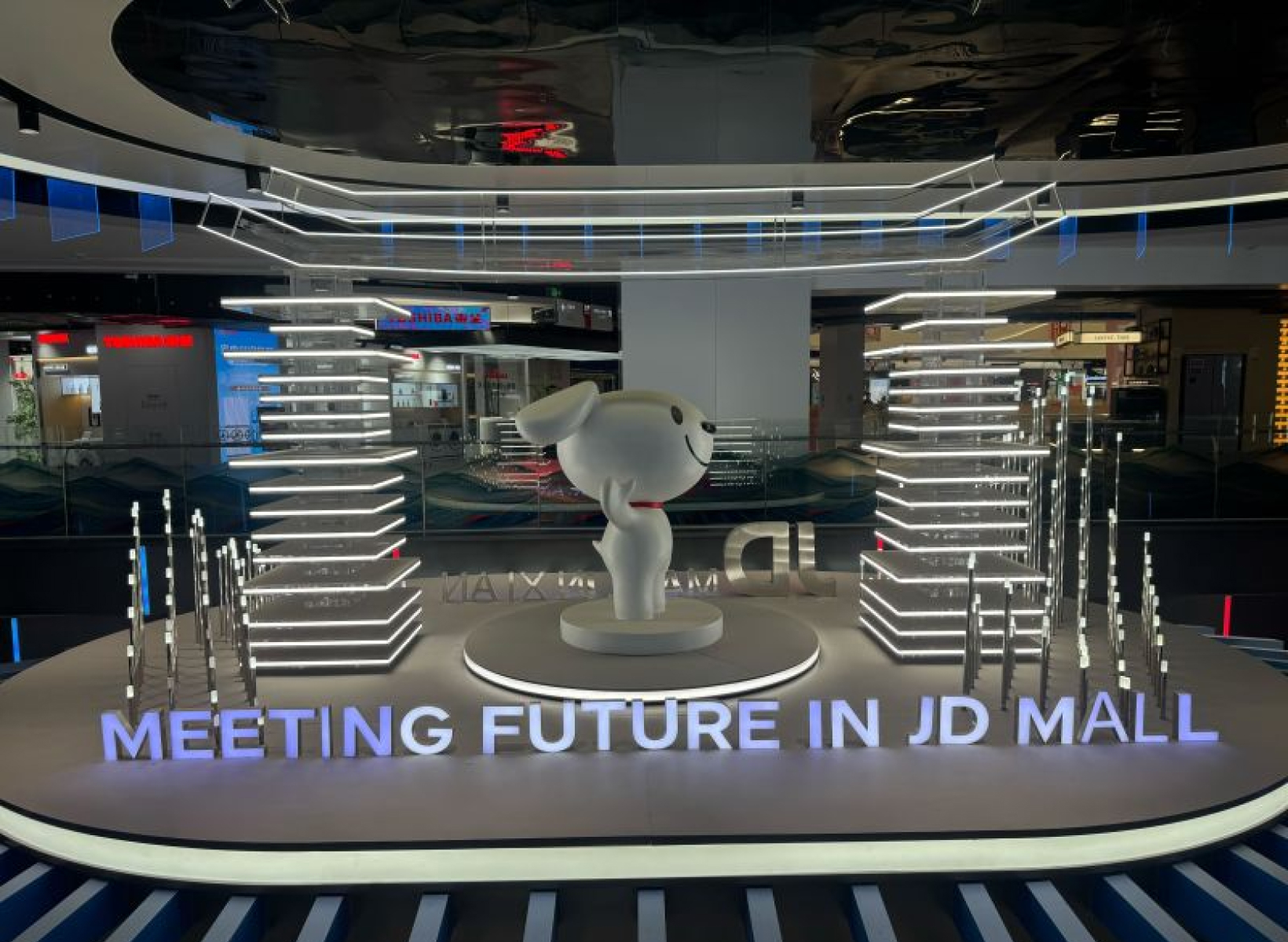
Instead of getting entangled in endless discount battles for the last, expensive online clicks, JD.com is investing in physical megastores. On our tour through Xi'an, we visited these gigantic retail spaces. The most strategically interesting aspect is how a digital pure-player approaches this brick-and-mortar expansion: Each location is selected with a highly analytical approach based on local customer and behavioral data, specifically to capture target groups that have become too expensive to reach digitally.
In the stores themselves, the focus is entirely on huge "experience zones." Consumers can physically experience and test the latest smart home technologies, gaming consoles, and gadgets like self-rolling suitcases in realistic scenarios. The store transforms from a sales space into an experience space. The transaction can ultimately take place digitally, but inspiration and trust are built offline. This is how JD.com leverages its data power in the physical world to escape the performance marketing trap.

The European Parallel: MediaMarktSaturn
This development is not a purely Asian phenomenon. If we look closely, we can already see this strategic realignment in the European market. A prominent example is the transformation of MediaMarktSaturn.
Here too, we see the pivot towards so-called "Experience Electronics" formats. Stores are being modernized, equipped with dedicated experience zones, and increasingly focused on consultation and trying out innovations. JD.com and MediaMarktSaturn are ultimately reacting to the same market pressure: If a product is available everywhere online with a single click at the same time, the physical space must offer tangible added value that e-commerce cannot provide. Nevertheless, I view brick-and-mortar expansion very critically; a purely physical presence cannot solve problems in differentiation or in offer and service curation. Furthermore, costs are also rising here: energy, skilled labor, big-city rents, and security can quickly approach online acquisition costs.
The Entry of Asian Tech Brands into the Local Market
One might dismiss this trend as an interesting strategic case study, were it not for a very direct threat to the European market. JD.com is not just building these experience structures for the Chinese domestic market – they serve as gigantic launchpads for global expansion.
In 2025, JD.com secured a large majority stake of over 70% in MediaMarktSaturn's parent company Ceconomy (DER SPIEGEL). Even though the final implementation and transaction are currently blocked in Austria by investment control, the strategic intent and infrastructure are in place (Handelsblatt, 2025). We are currently observing the development of a massive pipeline leading directly to Europe: Approximately 1,000 Chinese brands are currently pushing into the European electronics retail market at tremendous speed. These brands bring high-quality technology at aggressive prices and are now specifically looking for ways to gain the trust of European consumers. I was recently surprised by how profoundly this is already happening: when I attended the traditional Hamburg Show Jumping and Dressage Derby, the Chinese smart home brand Dreame prominently appeared as a sponsor.
What We Must Do in Europe Now
Price leadership has never been a desirable positioning. However, the answer also cannot be to blindly copy JD's capital-intensive model of gigantic experience stores – a concept that still needs to prove its long-term ROI.
Instead, we should radically strengthen our position as local gatekeepers. When Asian brands enter our market, they are looking for exactly what we already possess: established customer access and deep local trust. European retailers should stop being mere goods distributors and instead act as genuine, value-adding curators. Those who intelligently filter Asian tech ecosystems and combine them with excellent local service make themselves indispensable partners for these brands while simultaneously defending their own margins.
In the next blog post in this series, I will share my insights on the misunderstanding between Asian and European e-commerce – stay tuned!
.jpg)