.jpg)
An honest assessment of where corporate AI really stands, why most companies are stuck and how companies are successfully implementing AI transformation.
The 15.7 trillion dollar question
By 2030, generative AI could add 15.7 trillion US dollars to the global economy. That is more than the current GDP of China and India combined (PwC, 2025). McKinsey estimated in 2023 that Generative AI could add 2.6 to 4.4 trillion US dollars annually — roughly as much as the total economic output of the UK.
These figures have become so well-known that they have barely had any effect. Each board discussed the “AI opportunity.” And almost every company has responded: 78% of organizations now use AI in at least one business function — up from 55% just a year ago. (Stanford SHARK, 2025)
But here's the part that doesn't make the headlines: 95% of AI pilot projects in companies have no measurable business impact.
It's not a typo. According to the MIT study “State of AI in Business 2025,” companies invest 30-40 billion dollars in generative AI annually. The vast majority will get nothing in return — neither cost savings, nor increased sales, nor improved customer experience. Nothing that is reflected in the income statement.
This article explains why there is a gap between the oft-cited transformative potential and the disappointing reality — and in particular how the 5% of companies that actually create value can overcome the divide through a targeted enterprise AI strategy and effective AI adoption, while the remaining 95% lag behind.
The fastest technological change in human history
Before we analyze what's going wrong, it's worth recognizing what is truly unprecedented at this moment:
AI is the fastest technology in human history. It took 50 years for the telephone to reach 50 million users, and the Internet seven years. ChatGPT achieved this goal in just two months — and now has over 800 million weekly active users, around 10% of the world's population. (PYMNTS, 2025)
Within just two years of implementation, 40% of US adults had used generative AI. By way of comparison, the personal computer needed 12 years for similar distribution, the Internet four years after the launch. (Lucidity Insights, 2025)
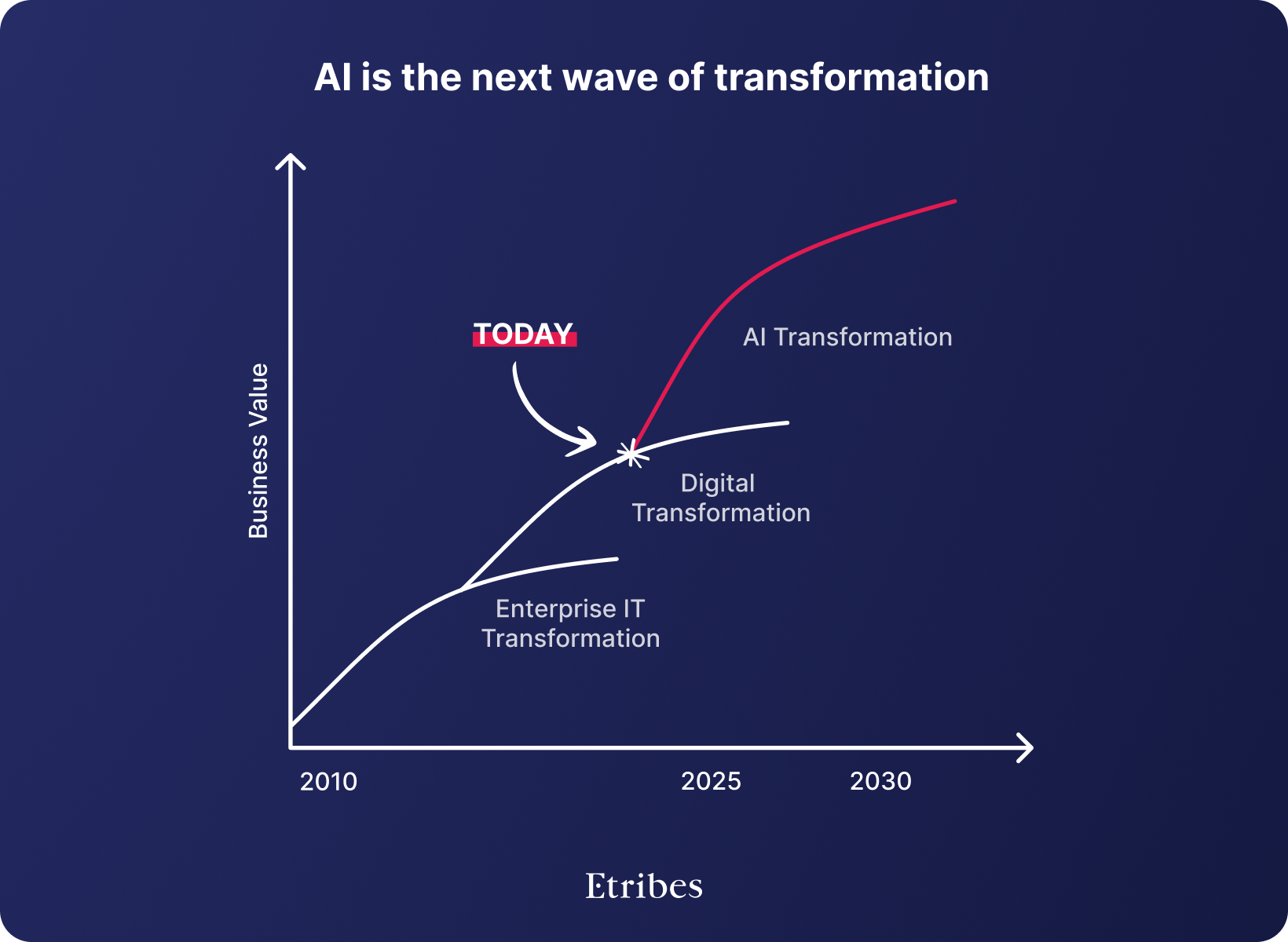
This speed creates a real strategic problem. Previous waves of technology — cloud computing, mobile, even the Internet — gave companies a decade or more to adapt. Managers were able to learn from early users and develop well-considered measures. AI transformation doesn't offer this luxury period. The S-curves are compressed. The gap between “emerging” and “mainstream” is shrinking. Many companies get stuck here.
The GenAI Gap: Two worlds are created
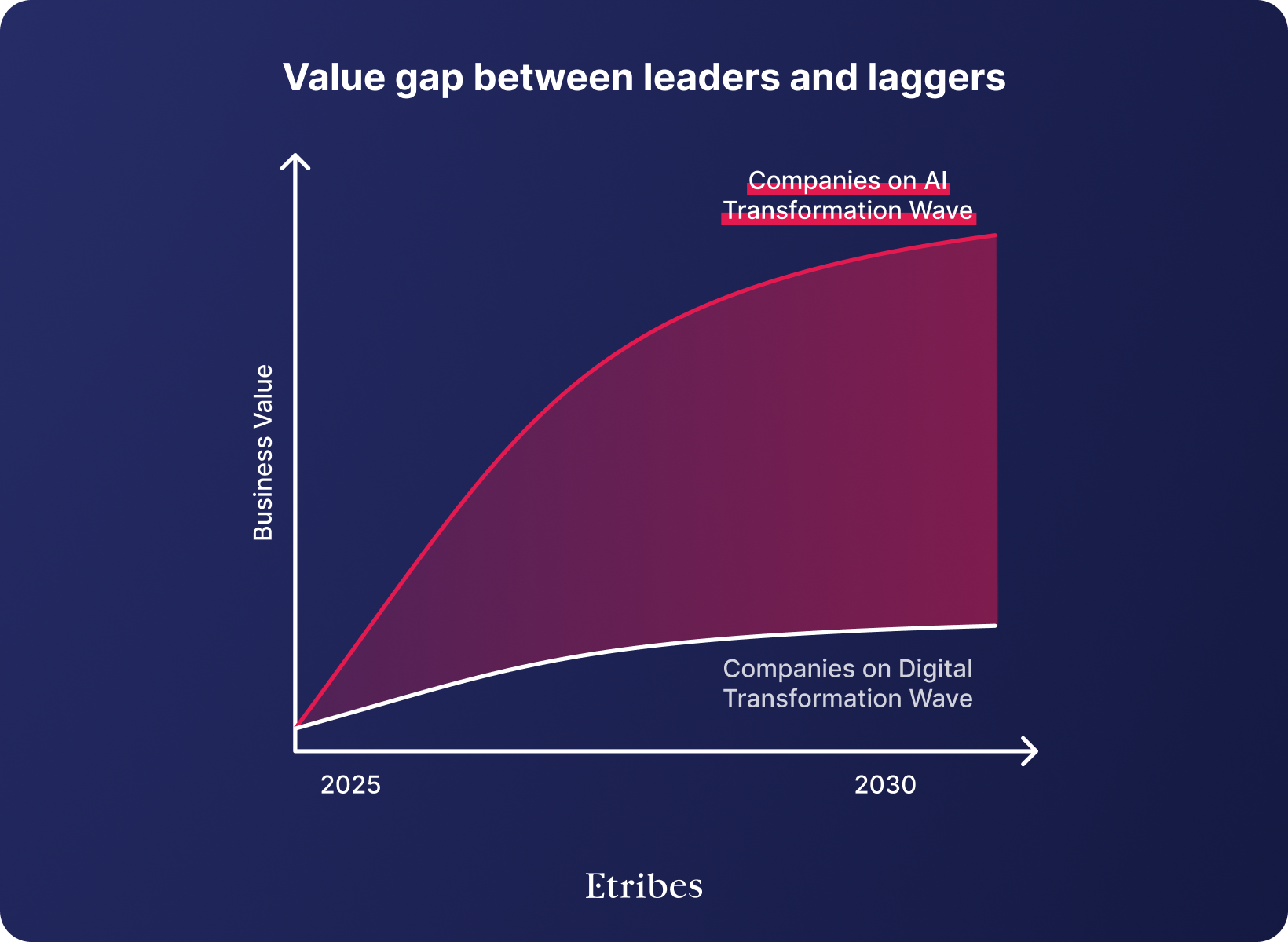
A new competitive discrepancy is emerging — not between “digital” and “analog” companies (this war was decided long ago). But between companies that achieve real added value through AI and those that are still carrying out isolated experiments.
The data is clear. According to BCG research 2025, AI pioneers — so-called “future-built” companies — achieve significantly better results than laggards:
Leader vs. Laggards metric
- Sales growth: Leaders grow 1.7x faster than Laggards.
- Three-year total return for shareholders: 3.6× higher for leaders.
- EBIT margin: Leaders achieve 1.6× higher margins.
- Return on Invested Capital (ROIC): 2.7× higher for leaders.
These are not marginal differences. AI leaders are moving away — and accelerating. They plan to invest twice as much in AI transformation as laggards in 2025 and expect double revenue gains and 40% larger cost reductions.
Latecomers don't stand still — they absolutely fall behind. Retailers that use autonomous AI are growing 50% faster than competitors. B2B salespeople who use AI effectively are twice as likely to exceed their goals. AI in business processes is increasingly becoming a prerequisite for competitiveness. (BCG, 2025)
What the gap actually looks like
On the one hand: companies with scattered pilots, “proof-of-concepts” that never become productive, AI demos at executive meetings, while business processes remain unchanged. They have AI initiatives but no AI transformation.
On the other hand, organizations in which AI is embedded in work processes. Recommendation systems measurably increase conversion. Customer service AI processes most routine inquiries cost-effectively. Content production that used to take weeks is done in hours. Experiments are a thing of the past here — AI is part of the company.
Only 5% of companies are currently considered “future-built”. Another 35% are actively scaling and starting to see value. The remaining 60%? Laggards with minimal gains — and without the ability to change that. (BCG, 2025)
The question isn't whether your company uses AI — almost everyone does. The question is which side you're on: the one that creates complementary benefits, or the one that only produces PowerPoint slides.
The pilot cemetery: Why 95% of AI initiatives fail
If the potential is so great and adoption is so widespread, why do almost all AI projects not add value? According to MIT 2025 research, it is not due to technology.
Figures from the cemetery:
- 80% + of companies have tested tools such as ChatGPT or Copilot
- 40% use these tools in some way.
- Only 20% reach the pilot phase for enterprise AI implementation
- Only 5% go into production.
The pattern is constant: Many projects start, almost none are completed. According to S&P Global, 42% of companies abandoned most of their AI initiatives in 2025 — up from 17% in 2024. On average, 46% of proof-of-concepts are discarded before they become productive. (S&P Global Market Intelligence, 2025)
At 80%, AI projects fail twice as often as traditional IT projects (Rand, 2024).
The five patterns of failure
1. Not a strategic anchor: Initiatives unrelated to core goals often fail. Teams build skills and find problems, while Innovation Labs work in isolation. More than half of the budget for generative AI goes to sales/marketing, but ROI mostly comes from back office automation. (WITH NANDA, 2025). Wrong AI, wrong reason.
2nd data gap: 57% have no data readiness (Gartner, 2024) For data controllers, data quality and completeness are among the main obstacles — more important than model accuracy or lack of talent.
3. Integration deficit: On average, an organization uses 897 apps, of which only 29% are integrated. Good integration brings 10.3x ROI, bad integration only 3.7×. AI that isn't connected doesn't change work. (MuleSoft, 2026)
4. Adoption desert: Many tools remain unused: 75% of employees need retraining for AI, yet only 35% receive sufficient training. (MuleSoft, 2026) Shadow AI is everywhere. Only 40% of companies have official LLM subscriptions, but employees from over 90% of the companies surveyed use personal tools every day. Security risks exist but are often ignored. (WITH NANDA, 2025)
5. Governance vacuum: Shadow AI is omnipresent. Only 40% of companies have official LLM subscriptions, but employees from over 90% of the companies surveyed use personal tools every day. Security risks exist but are often ignored. (WITH NANDA, 2025)
Core barrier: Not infrastructure, regulation, or talent — but learning. AI must learn and adapt organizationally. Companies in the pilot cemetery treat AI as a technology procurement; successful companies treat AI as an organizational learning problem.
What actually works
MIT and McKinsey research shows a clear pattern: Companies that successfully scale AI are working on four dimensions simultaneously — not sequentially, not in isolation.
1. Strategic orientation: AI must be focused on P&L. High-performers focus on an enterprise AI strategy that is anchored to core business goals — not on isolated individual cases. 75% of GenAI's value potential lies in customer-oriented operations, marketing & sales, software engineering and R&D. (McKinsey, 2023)
2. Technology & data: Quality data, integration architecture, and infrastructure that enable AI to learn from productive processes are central to successful AI implementation in companies and measurable business results. Vendor solutions are 67% successful in implementing AI, self-construction only 33%. (WITH NANDA, 2025)
3. Organization & Adoption: AI must be integrated into workflows. 55% of high-performers fundamentally redesign workflows, others just 18%. Training, change management, and AI governance are critical for effective AI adoption. (McKinsey, 2025)
4. Learning systems: Feedback loops, continuous improvement, and measurement of real business success are critical. Large companies need 9 months to scale, SMEs just 90 days — the difference lies in the ability to learn. (WITH NANDA, 2025)
Proven use cases from the market
There are already clearly proven, market-proven AI use cases with measurable ROI. The technology is ready, the results are reliable — and the question is no longer whether, but how quickly, a company activates the appropriate levers.
At the same time, we are seeing how new categories of use cases are only just becoming possible — for example through agent-based AI systems that not only assist but also take on tasks independently.
We see four areas in which no one should wait anymore.
Software development: AI as a co-developer
AI-powered coding assistants such as GitHub, Copilot or Cursor are fundamentally changing software development. Developers complete tasks up to 55% faster — not due to lower quality, but through intelligent autocompletion, test generation, and refactoring suggestions. At Google, over a quarter of all new code is now AI-generated and then tested and approved by engineers. (Ars Technica, 2024)
For companies, this means faster feature development, lower development costs and the ability to build ambitious digital products even with smaller teams. Especially in medium-sized companies, where IT resources are often scarce, the lever is enormous.
Content creation with AI: weeks become days
Perhaps no area shows Generative AI's ROI more clearly than content creation. Zalando has set standards here: With AI-generated digital twins of real models, the company was able to reduce the production time for campaign images from 6-8 weeks to 3-4 days — at around 90% lower costs. In the fourth quarter of 2024, around 70% of all editorial campaign images were already AI-generated. (Reuters, 2025)
Zeiss, a global B2B group, also reduced its content creation costs by around 80% and halved campaign production time through the use of generative AI in marketing. (Adobe Summit, 2025)
With the new opportunities, there are also new challenges. The public often reacts negatively to AI-generated content. Here, companies can already benefit from the experience of pioneers — e.g. people for communication around the core of the brand, AI for the long-tail.
Customer service: AI in customer contact
Automating customer service through AI is one of the best documented use cases — and one of the most economically effective. Klarna is the most prominent example: The Swedish fintech's AI assistant does the work of 853 full-time service employees, reduced the solution time from 11 minutes to less than 2 minutes and saves the company 60 million US dollars a year. (Klarna Q3 2025 Investor Presentation)
The learning curve is instructive: Klarna started with a pure AI approach, then discovered that complex and emotional concerns still need human agents, and developed a hybrid model. That is not failure — it is exactly the type of iterative industrialization that distinguishes the pilot cemetery from scaled deployment.
Personalization: Using AI to address each other individually
AI-driven personalization today delivers measurable commerce KPIs — not as promises, but as results. DocMorris, Europe's leading online pharmacy, increased search conversions by +112% and net revenue by +147% through AI-based search with dynamic re-ranking. (Algolia Case Study, 2025)
The pattern is consistent across industries: Where AI shows customers the right product at the right time, conversion, shopping basket size and customer satisfaction increase measurably.
Etribes as a partner for AI transformation
The examples show that the added value of AI is no longer a theoretical promise — it is market-proven and measurable. The key question for companies isn't “Should we use AI?” , but: “How do we go from recognition to implementation?”
From our Experience in AI consulting There are two complementary levers for this, which work together in practice:
Implement the most important use cases quickly and scalably
The most common mistake: Companies start with pilots that are not designed for productive use right from the start. The results are impressive demos that never become part of a real AI implementation in a company.
The better way: Identify the two to three use cases with the highest expected P&L impact and implement them directly so that they can scale. This means: correct data connection instead of test data, integration into existing systems instead of a standalone solution and employee enablement from day one.
A “value sprint” of 1-2 weeks is often sufficient to identify the most promising levers along the value chain and to prioritize them with a rough ROI assessment. Implementation then begins: no pilots for the pilots' sake, but production-ready AI solutions with clear performance measurement.
An example from our practice as a digital and AI consultancy: In just a few weeks, we implemented an AI assistant for booking appointments by telephone for one of the largest automotive service chains in Germany. The special feature: The assistant also answers calls outside opening hours and when lines are busy — situations in which business has been lost so far. The result was an unexpectedly high volume of additional appointment bookings combined with a high level of customer satisfaction. Not a pilot that disappeared in the lab — but a productive AI implementation that generates revenue from day one.
Strategically set up the transformation path
Individual use cases solve individual problems. But the 5% of companies that derive real competitive advantage from AI are doing something else: They systematically quantify all relevant AI levers across the entire value chain — and thus create the basis for a prioritized enterprise AI strategy.
AI impact quantification does just that: In a short period of time, revenue and cost structures are analyzed, AI levers are systematically derived and their impact is consolidated in a P&L model. The result is not a PowerPoint strategy, but a quantified investment case for AI transformation with specific levers, costs and expected returns.
On this basis, a roadmap is created that not only addresses technology, but also data architecture, organizational change and governance — the four dimensions that determine success or failure.
Both levers are not mutually exclusive — they are strengthening. Companies that start with a specific use case and at the same time create the strategic basis through AI strategy advice avoid the pilot cemetery because every implementation is embedded in a larger context right from the start.
Find out on our service page more about how our AI experts support companies with AI consulting, AI implementation and sustainable AI adoption.